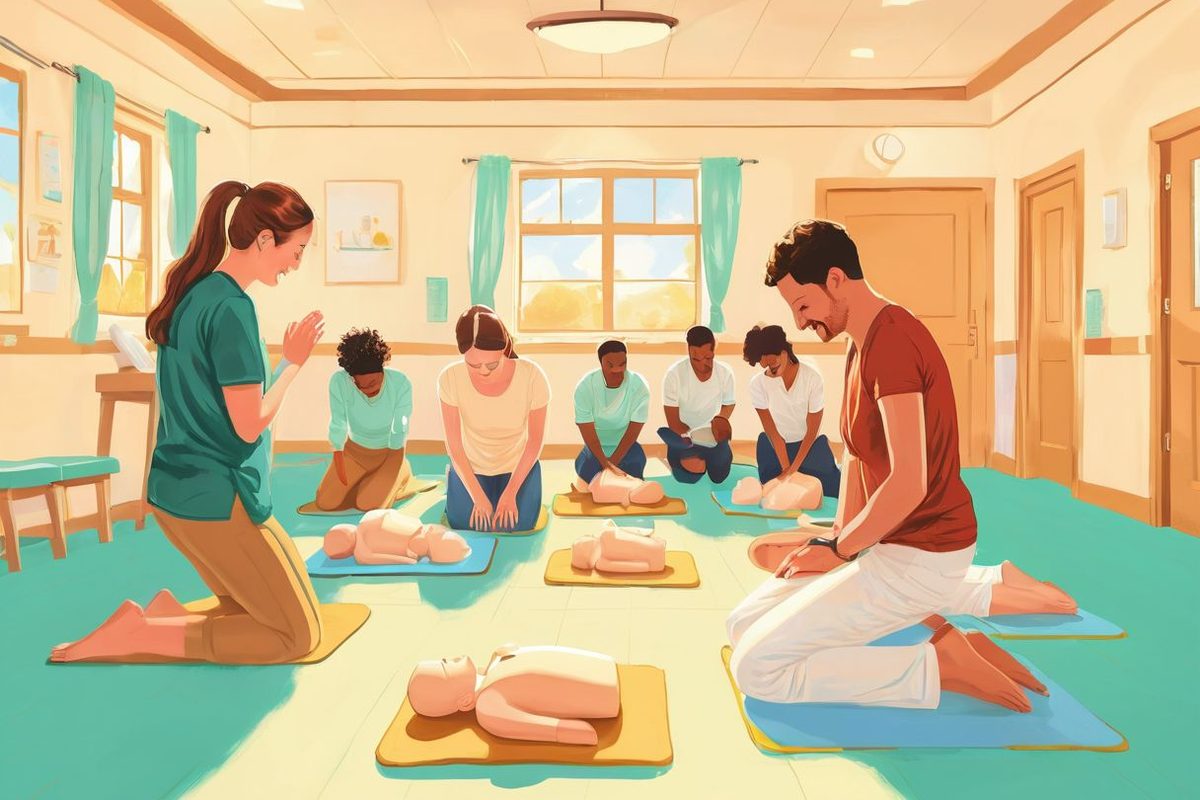
You can learn the basics of first aid and CPR for free, at home, in less than an hour. Good places to start are the British Red Cross first aid app, the British Heart Foundation’s 15-minute RevivR CPR course, and St John Ambulance’s online advice. It also helps to know how to find your nearest defibrillator.
Free learning like this does not give you a workplace first aid qualification. It does give you the skills and confidence to help in an emergency.
A simple plan to get started
- Do the free RevivR CPR course (about 15 minutes).
- Download the free British Red Cross first aid app, and the baby and child app if you look after children.
- Look up your nearest defibrillator on DefibFinder.
- Bookmark the St John Ambulance first aid advice pages.
- Check your home first aid kit.
Learn CPR: RevivR from the British Heart Foundation
RevivR is a free online CPR course from the British Heart Foundation. It takes about 15 minutes.
You need a phone or tablet and a cushion to practise on. If you allow camera access, it gives you feedback on your chest compressions. The BHF says it does not record or save camera images. It also walks you through a practice 999 call.
It teaches you how to:
- spot a cardiac arrest
- call 999 and what to expect on the call
- do CPR
- use a defibrillator and find your nearest one
You can get a certificate when you finish. Try RevivR on the BHF website.
Lifesaver from Resuscitation Council UK
Lifesaver is a free online course from Resuscitation Council UK, the body that writes the UK’s resuscitation guidelines. It is like an interactive film: you work through four scenarios and make choices that change the outcome. It covers CPR and first aid, and works on a computer or phone. Find Lifesaver on the Resuscitation Council UK website.
British Red Cross
The British Red Cross offers free ways to learn:
- First aid app: free for Android and iPhone. It has more than 20 skills with step-by-step guides, videos and quizzes. It works without an internet connection.
- Baby and child first aid app: free, with 17 skills and a place to record a child’s medical needs.
- Free online learning for babies and children: self-paced, at any time.
- Short skill videos: learn skills a few minutes at a time.
- Free workshops for adults: basic skills sessions, online or face to face. These do not give a qualification.
See British Red Cross first aid apps and ways to learn first aid.
St John Ambulance
St John Ambulance has free first aid advice on its website, checked by its clinical team. It covers CPR for adults, children and babies, choking, bleeding, burns, fractures, heart attack, stroke, seizures, sepsis, allergic reactions and much more. Read St John Ambulance first aid advice.
It also has free resources, such as posters, Easy Read guides and British Sign Language guidance.
Free sessions for community groups in England
St John Ambulance runs free first aid awareness sessions in England for schools, local groups and community organisations. You need at least 6 people. Sessions for adults and for families last up to 90 minutes and cover CPR, using a defibrillator, severe bleeding and choking. They are not for workplace training and do not give a certificate. In Wales, Scotland and Northern Ireland, contact your local St John Ambulance or St Andrew’s First Aid.
The old St John Ambulance app
St John Ambulance’s old first aid app has been withdrawn. If you still have it on your phone, delete it, because the information is out of date.
citizenAID: for serious incidents
citizenAID is a UK charity that teaches the public what to do in a serious incident with several injured people, such as a stabbing, shooting, bombing, vehicle or acid attack. Its app is free and has no adverts. It gives step-by-step guidance, including:
- how to keep yourself and others safe
- quick ways to decide who to help first
- how to deal with life-threatening bleeding
- what to tell 999, with a button that opens your phone’s dialler
The app is on the Apple App Store and Google Play. Read about the app on the citizenAID website.
Download on the App Store: citizenAID for iPhone or iPad (opens in a new tab)
Get ready before you need it
- Download the app now, while things are calm.
- Spend ten minutes looking through it, so you know where things are.
- Share it with your family, and suggest they download it too.
Find your nearest defibrillator
A defibrillator (AED) can restart a heart in cardiac arrest. Anyone can use one: switch it on and follow the prompts. You don’t need training.
The Circuit is the UK’s national defibrillator network, run with the British Heart Foundation. When you call 999 about a cardiac arrest, ambulance services use it to find the nearest registered defibrillator and direct you to it.
To check before an emergency, enter a postcode on DefibFinder. It only shows defibrillators registered on The Circuit. If your community group or workplace has a defibrillator, you can register it free on The Circuit.
In a real emergency
If someone is unresponsive and not breathing normally:
- Call 999 on speaker.
- Start CPR: push hard and fast in the centre of the chest.
- Send someone for a defibrillator if you can.
- Follow the call handler’s instructions.
Don’t worry about hurting them: the risk of harm from CPR is low. See how to call 999.
When to get help
- Call 999 if someone is unresponsive, not breathing normally, choking and can’t breathe, bleeding heavily, or has signs of a heart attack, stroke or a severe allergic reaction.
- Use NHS 111 online or call 111 for injuries or illness that need help soon but are not life-threatening.
- Contact your GP practice for minor injuries that are slow to heal.
- Ask a pharmacist about what to keep in your first aid kit and treating minor cuts, burns and stings.