The NHS offers free weight loss apps you can download today without a referral: the NHS Weight Loss Plan app for healthier eating and the Couch to 5K app for getting active. If you have diabetes or high blood pressure, your GP surgery or pharmacist may refer you to the free NHS Digital Weight Management Programme. Weight loss medicines are available on the NHS for some people, through your GP or a specialist service, but only after an assessment.
If you have a health condition, follow a special diet for medical reasons, or have had an eating disorder, talk to your GP before you change how you eat.
Free NHS diet apps you can start yourself
NHS Weight Loss Plan app
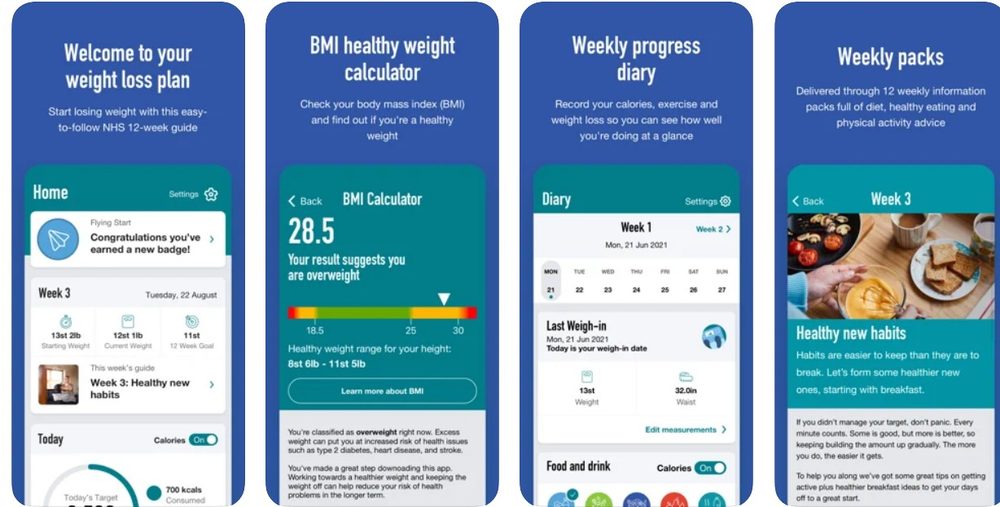
This is the free NHS diet app. It is a 12-week plan to help you build healthier eating and activity habits that last.
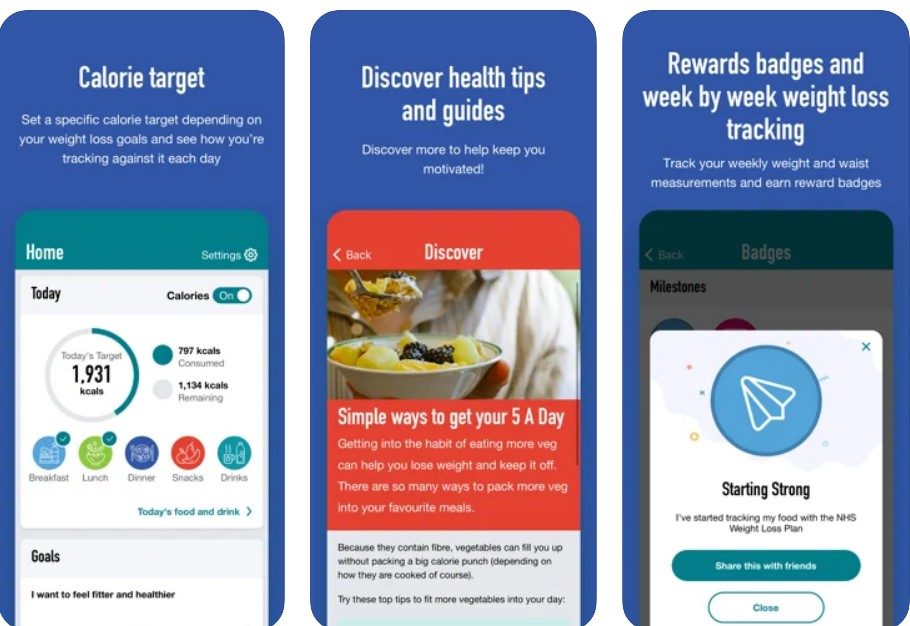
With the app you can:
- set a 12-week weight loss goal
- set a daily calorie target
- keep a food diary of what you eat
- use the BMI calculator and record your weight each week
It is free on the Apple App Store and Google Play.
Download on the App Store: NHS Weight Loss Plan for iPhone or iPad (opens in a new tab) Get it on Google Play: NHS Weight Loss Plan for Android (opens in a new tab)
A Public Health England evaluation published in 2021 looked at 8,305 people who finished all 12 weeks. On average they reported losing 5.8kg. The weights were self-reported, and the figure only covers people who completed the plan, so it does not show what happens for everyone who starts.
Is there a printable version? The plan used to come as 12 weekly printable guides, each with a list of actions for the week. The NHS Better Health website now offers the app instead and does not link to printable guides. If you cannot use an app, ask your GP surgery or local council what weight management support they offer.
What people say about the Weight Loss Plan app
On the UK App Store the app has an average of 4.5 out of 5 from about 5,900 ratings (checked 28 October 2026). A few of the reviews shown there:
- “I had really lost faith in losing weight until I found this app.” (March 2024)
- “Full of useful information and a calorie counter/weight loss record.” (October 2020)
- “The app is fine if a little on the basic side.” (February 2021)
Reviews are personal views. Nobody checks the results people report, and what works for one person may not work for you.
Couch to 5K
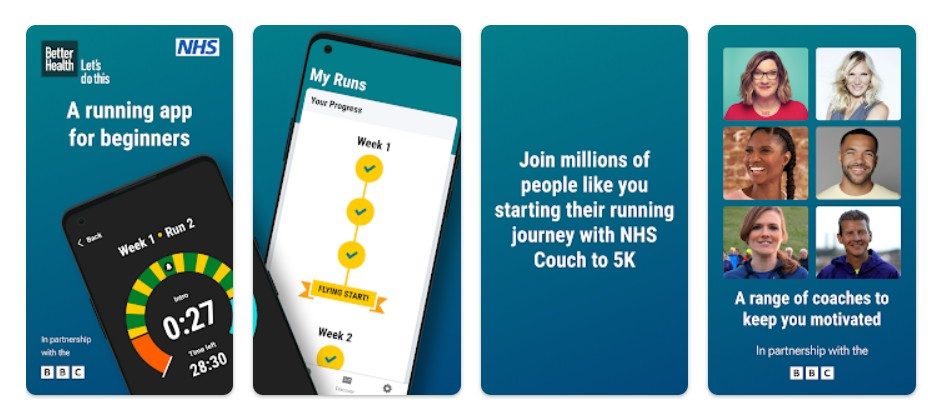
Couch to 5K is a free NHS running plan for complete beginners, made with the BBC. It takes about 9 weeks, with 3 runs a week and a rest day between each run. Audio coaching mixes running and walking. The runs build up until you can run for 30 minutes without stopping.
You can choose your coach, listen to your own music and repeat a week if you need to. The coaches have included Jo Whiley, Sarah Millican, Sanjeev Kohli, Steve Cram, Dame Denise Lewis, Reece Parkinson, Yasmin Evans and the footballer Ella Toone. It is meant for anyone, whatever their fitness. If you are worried about your health, speak to a GP before you start.
It is free on the Apple App Store and Google Play.
Download on the App Store: NHS Couch to 5K for iPhone or iPad (opens in a new tab) Get it on Google Play: NHS Couch to 5K for Android (opens in a new tab)
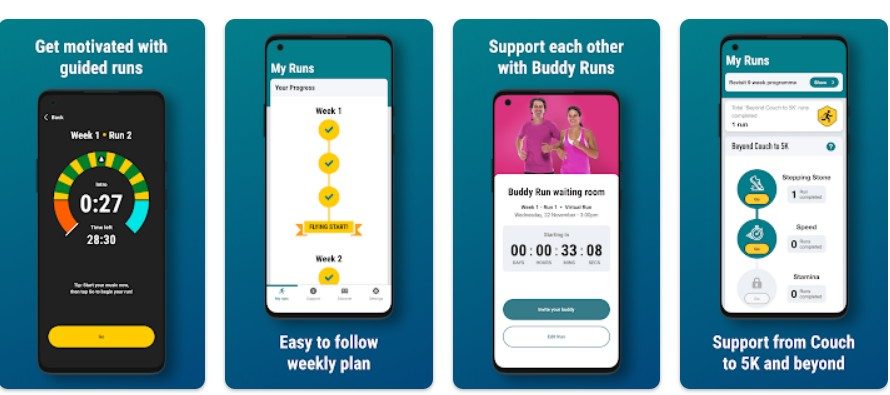
The app’s Buddy Runs feature, for running with a friend, was paused for maintenance in the latest App Store version.
Couch to 5K week by week
Every run starts with a 5-minute brisk walk to warm up and ends with a 5-minute walk to cool down.
| Week | What the runs look like |
|---|---|
| 1 | Run 1 minute, walk 90 seconds, repeated |
| 2 | Run 90 seconds, walk 2 minutes, repeated |
| 3 | Runs of 90 seconds and 3 minutes, with walks in between |
| 4 | Runs of 3 and 5 minutes, with walks in between |
| 5 | Builds up to a 20-minute run without stopping |
| 6 | Builds up to a 25-minute run |
| 7 | 25-minute runs |
| 8 | 28-minute runs |
| 9 | 30-minute runs |
The NHS says rest days help prevent injury and are as important as the runs. It is fine to repeat any run or week.
Ready for your first run?
There is no right pace. Many people walk more than they planned, repeat a week or take a break and come back. That still counts as progress. What matters is that you keep going at a pace that suits you.
What to do after Couch to 5K
When you finish week 9, you can:
- download and print a Couch to 5K certificate from the NHS website
- repeat the last few weeks to build confidence
- use the “Beyond Couch to 5K” runs in the app, which open up once you finish, to work on speed and stamina
- try parkrun, a free weekly 5km event where you can walk, jog or run at your own pace
- keep running regularly so it becomes part of your week
For company along the way, the NHS points to the Couch to 5K Facebook group and the HealthUnlocked community. There is also a BBC Couch to 5K podcast with stories from people who finished the plan.
What people say about Couch to 5K
On the UK App Store the app has an average of 4.8 out of 5 from about 402,000 ratings (checked 28 October 2026). A few of the reviews shown there:
- “This has completely changed my life, I am the fittest I have ever been.” (August 2019)
- “Couch to 5 K ticked the cardio box for me.” (July 2024)
- “The way the runs are designed is pure genius.” (May 2020)
These are personal views, not checked results.
Better Health resources
The NHS Better Health website has more free help:
- healthy eating, portion sizes and calorie advice
- recipes under 600 calories per portion
- 10-minute home workout videos for beginners, covering cardio, strength and stretching
- a BMI calculator, and a waist-to-height ratio calculator
- a short Healthy Choices Quiz that gives personal tips
- links to local free and discounted weight loss programmes
How to get started
- Check your weight with the NHS BMI calculator on the Better Health website. It tells you whether a healthy weight range applies to you.
- Download the NHS Weight Loss Plan app and set a goal you feel is realistic.
- Add some activity. Try Couch to 5K or the home workout videos, at your own pace.
- Look at local programmes. Some areas offer free weight management groups you can join without seeing a GP. Your GP surgery or local NHS website can tell you what is available.
- Talk to your GP surgery if you have a health condition linked to your weight, or the apps alone are not enough.
Everyday habits that help
These are the habits the NHS recommends. They help whether or not you also take a weight loss medicine.
- Eat a balanced diet. Changing what you eat is what helps you lose weight. Moving more helps you keep it off.
- Be active. The NHS advises adults to do at least 150 minutes of moderate activity a week, such as brisk walking, or 75 minutes of vigorous activity. Spread it over 4 to 5 days or more. Add strengthening activity on at least 2 days. If you are starting from nothing, start small and build up: any activity is better than none.
- Sit less. Break up long spells of sitting with some movement.
- Sleep well. Most adults need around 7 to 9 hours a night. The NHS says poor sleep can make it harder to lose weight, partly because tiredness pushes people towards higher-calorie food.
- Watch your drinks. Aim for 6 to 8 cups or glasses of fluid a day, mostly water and other low-calorie drinks. Sugary drinks and alcohol add calories.
- Get support. A local programme, a running group or an online community can help you keep going. You do not have to do it alone.
Other diet and calorie-counting apps
Many people use commercial diet apps. These are not NHS apps, and this site earns nothing from them. We checked each app’s own store listing on 28 October 2026. Most have a free version and a paid upgrade. App store prices are in US dollars on the listings we could open, so check the UK price in your app store before you subscribe.
| App | What it focuses on | Free to use? |
|---|---|---|
| Cronometer | Detailed nutrients: calories plus vitamins and minerals | Yes. Paid “Gold” upgrade removes ads and adds features |
| MacroFactor | Adjusts your calorie and protein targets each week as your weight changes | No free version. 7-day free trial, then a subscription |
| MyNetDiary | Everyday food diary with barcode scanner, exercise and water tracking | Yes. Premium adds meal planning and device syncing |
| Lose It! | Simple calorie counting with a large food database | Yes. Premium adds barcode scanner and meal plans |
| YAZIO | Calorie counting with a barcode scanner, plus an optional fasting tracker | Yes. PRO subscription adds more features |
| Eated | Logging what you eat and how you feel, with no calorie counting | Yes. Premium adds lessons and daily tasks |
| Hava | Choosing foods that keep you full, rather than counting calories | Free trial, then a subscription |
| CalorieDaddy | Calorie tracking with blunt, “tough love” feedback | Short free trial, then a subscription |
A few points to bear in mind:
- CalorieDaddy is very new and had only a handful of ratings when we checked. Its blunt tone will not suit everyone.
- Hava is made by Diet Doctor, a Swedish company. Its idea is “satiety per calorie”: choosing foods that fill you up for fewer calories. Its claims come from the company’s own data, not from an independent trial.
- No app replaces medical advice. If you have diabetes or another condition, or you take medicines that affect your weight or blood sugar, ask your GP surgery or pharmacist before you start a new eating plan.
Do diet apps work?
They can help a little, mainly if you keep using them. Research summarised below suggests:
- The effect is modest. A 2022 review of trials found weight loss apps helped people lose about 2kg more than comparison groups at 3 months, falling to about 1.6kg at 12 months.
- Downloading an app is not enough on its own. In a 2014 US trial, primary care patients who were helped to download a free calorie-counting app lost no more weight after 6 months than those who were not. Use of the app dropped sharply over the following months.
- A plan helps. In a 2019 trial, people given a 12-week app programme with a personal calorie target lost about 2.5kg on average in 3 months.
- Coaching may add a little. A 2023 review found apps combined with health coaching helped people lose about 2kg more than usual care. It was not clear that coaching added much compared with using an app alone.
- Calorie counting is linked with better results. A 2014 review of weight management programmes found those that helped people count calories were linked with more weight loss.
Are free apps good enough?
For most people, yes. The free NHS Weight Loss Plan does the core job: a calorie target, a food diary and weekly weigh-ins. Paid upgrades add extras, but using an app regularly matters more than which one you pick.
Tips to get the most from a diet app
- Log what you eat most days, even if it is not perfect.
- Use the barcode scanner, or weigh portions now and then, to keep your entries accurate.
- Look at your progress once a week, not after every meal.
- Use reminders if they help you keep going.
- Stop if tracking starts to make you anxious (see below).
NHS Digital Weight Management Programme
This is a free 12-week online programme, used on a smartphone, tablet or computer. NHS England says you may be able to join if you:
- are 18 or over
- have a BMI of 30 or more, or 27.5 or more if you are from a Black, Asian or other ethnic minority background
- have been diagnosed with diabetes, high blood pressure, or both
- can get online
You cannot refer yourself. NHS England says GP practices and community pharmacies can currently refer people, so ask your GP surgery or a local pharmacist. NHS England also plans to double the programme’s capacity by 2028 to 2029.
Some hospitals are also trialling referrals for people on surgical waiting lists. Taking part does not affect your place on the list.
Weight loss medicines on the NHS
The NHS can prescribe weight loss medicines to some people. They include semaglutide, tirzepatide and liraglutide, which help reduce appetite, and orlistat, which reduces how much fat your body absorbs.
The brand names can be confusing:
| Medicine | Brand for weight loss | Brand for type 2 diabetes |
|---|---|---|
| Semaglutide | Wegovy | Ozempic and Rybelsus |
| Tirzepatide | Mounjaro | Mounjaro |
| Liraglutide | Saxenda | Other brands |
So people often say “Ozempic” when they mean a weight loss injection, but in the UK Ozempic is a diabetes medicine. The semaglutide brand for weight loss is Wegovy.
Whether you can have these medicines depends on your BMI and whether you have health conditions affected by your weight. They are given alongside support with diet and activity, not instead of it.
What NICE says about tirzepatide
NICE recommends tirzepatide for adults with a BMI of at least 35 and at least one weight-related condition, such as high blood pressure, type 2 diabetes or sleep apnoea. The BMI threshold is usually 2.5 lower for people from South Asian, Chinese, other Asian, Middle Eastern, Black African or African-Caribbean backgrounds.
It is being introduced in stages. For the first 3 years, only people with the highest clinical need can have it. NICE expects everyone covered by its recommendation to have access within 12 years. So even if you meet the criteria, you may not be offered it yet.
How to ask
- Book an appointment with your GP surgery to talk about your weight.
- They can check your BMI and health, and explain the options available locally.
- They may refer you to a specialist weight management service. Eligibility rules differ between GP prescribing and specialist services.
Ask about benefits, risks and side effects, and what happens if it does not work. The most common side effects include feeling or being sick, diarrhoea and constipation. Do not stop a weight loss medicine suddenly without talking to your doctor.
Medicines and lifestyle changes work together
Some people see injections and lifestyle changes as a choice between two options. The NHS sees them as working together:
- Medicines need lifestyle changes. The NHS says semaglutide, tirzepatide and liraglutide help you lose weight when you combine them with exercise and changes to your diet.
- Weight often comes back after stopping. The British Heart Foundation reported a 2025 study of people who stopped tirzepatide after losing weight. A year later, 82% had regained at least a quarter of the weight they lost, and 9% had regained all of it. The study was funded by the drug’s maker and has limits, but it fits a wider pattern.
- Habits help you keep weight off. If you come off these medicines, a balanced diet and staying active help you keep the weight off. Habits you build now help whichever route you take.
- Lifestyle changes are safe for most people, but not risk-free for everyone. If you have a health condition, check with your GP before you start a new exercise plan or change how you eat.
Healthy eating and activity bring other benefits too, such as better fitness and mood. For many people they are the place to start. For some, a medicine is also the right choice. Your GP can help you decide.
Do not buy from unregulated sellers
The MHRA, the UK medicines regulator, warns people not to buy weight loss medicines without a prescription. All GLP-1 “weight loss jabs” are prescription-only and should only be supplied after a clinical assessment.
Products from social media, beauty salons or unregulated websites may be fake, contaminated or the wrong dose. Genuine injections come as pre-filled pens. Powder vials that you mix yourself are not authorised.
If you get treatment privately, use a UK-registered pharmacy. Online pharmacies such as Pharmacy2U offer private weight loss treatment after an online consultation with one of their clinicians. Whichever service you use, check the pharmacy on the General Pharmaceutical Council register, or the Pharmaceutical Society of Northern Ireland register. Private treatment is paid for, and prices vary, so compare costs and ask what support comes with it. You can report suspected fake products or side effects through the MHRA Yellow Card scheme. See checking your medicines online.
Other NHS support
- Smart scales can help some people track progress at home. See the smart scales guide.
- Prescription costs: if you pay for prescriptions, see NHS prescription costs.
- Weight loss surgery may be offered to some people with a higher BMI. Your GP can explain whether it applies to you.
If food or weight is causing you distress
If you are worried about your eating, or someone else’s, talk to your GP. The eating disorder charity Beat runs a free helpline (Beat: Support now):
- England: 0808 801 0677
- Scotland: 0808 801 0432
- Wales: 0808 801 0433
- Northern Ireland: 0808 801 0434
Calorie counting and food diaries are not right for everyone. If you have had an eating disorder or find that tracking makes you anxious, it is fine to skip them and focus on activity, sleep or wellbeing instead.
When to get help
- Call 999 if you or someone else has signs of a severe allergic reaction (anaphylaxis), such as a swollen throat or tongue, or difficulty breathing.
- Use NHS 111 online or call 111 if you are taking a weight loss medicine and think you are having a serious side effect. This includes severe stomach pain that does not go away, or signs of very low blood sugar, such as confusion, sweating, dizziness or a fast heartbeat.
- Contact your GP surgery if you are losing weight without trying, you have a long-term condition and want to lose weight, or you would like a referral to the Digital Weight Management Programme.
- Ask a pharmacist about side effects of a medicine you have been prescribed, or about a referral to the Digital Weight Management Programme.