For most people, a plain digital scale that weighs accurately is all you need. Weigh yourself at the same time of day, on a firm floor, every week or so, and look at the trend rather than single readings. Body fat and muscle readings from “smart” scales are rough estimates. People with a pacemaker or other implanted electronic device should not use those features.
What a scale can tell you
Weight
Weight is the most useful number. A good digital scale shows changes of 100g. Over weeks, the trend tells you whether your weight is going up, down or staying steady.
BMI
BMI (body mass index) compares your weight with your height. The NHS uses these adult ranges:
| BMI | Most adults | South Asian, Chinese, other Asian, Middle Eastern, Black African or African-Caribbean background |
|---|---|---|
| Overweight | 25 to 29.9 | 23 to 27.4 |
| Obese | 30 or more | 27.5 or more |
The lower figures exist because people from these backgrounds can have health problems at a lower BMI.
BMI has limits. It cannot tell muscle from fat, so a muscular person can be classed as overweight. It is for adults only, and the NHS calculator is not for use in pregnancy.
You can work out your BMI with the NHS BMI calculator. You do not need a smart scale for that.
Waist size
The NHS suggests that, if your BMI is under 35, your waist should be less than half your height. A tape measure is a cheap and useful partner to any scale.
What smart scales add, and their limits
Body composition scales send a very small electrical current up through your feet. This is called bioelectrical impedance. From it, the scale estimates body fat, muscle and water.
These figures are estimates, not measurements. Treat them as a rough guide to change over time in the same person, not as exact numbers. Makers say some readings are unreliable in certain situations. For example, Withings and Omron both say body fat readings will not be accurate in pregnancy.
A scale can flag a change in weight. It cannot tell you why. That needs a clinician.
What an app-linked scale adds
A scale that links to an app on your phone does more than show today’s number:
- Trend graphs. The app plots your weight over weeks and months. This puts day-to-day ups and downs in perspective, so one heavy reading after a holiday or a big meal is less discouraging.
- Goals and reminders. Many apps let you set a target weight and remind you to weigh in.
- Family use. Some scales recognise several people, so a household can share one scale and keep separate records. Check how many users a scale supports (see the table below).
- Sharing. Some apps can pass readings to other health apps on your phone, such as Apple Health, or let you export them to share with your GP practice. If this matters to you, check the app’s store listing before you buy.
What research says about weighing yourself
Regular self-weighing is one of the habits most linked with losing weight and keeping it off. A smart scale makes it easier, because readings are saved automatically. But the evidence is about the habit, not about any brand of scale.
- Weighing often helps people lose weight. In a 6-month US trial using scales that sent weights to a website, people who weighed every day lost about 6kg more than people who weighed on most, but not all, days. They also took up more healthy habits (Steinberg and others, 2015).
- People who keep weight off tend to weigh themselves. A 2005 review of a large US register of people who had lost a lot of weight and kept it off for years found that regular self-weighing was one of their common habits, along with being active and eating a consistent, lower-calorie diet (Wing and Phelan, 2005).
- Wi-Fi scales record how often people really weigh. A 2018 trial used Wi-Fi scales to track weighing. People tended to overestimate how often they weighed, but weighing more often was linked with more weight loss at 12 and 24 months (Crane and others, 2018).
These studies were mostly in the US, with people taking part in weight loss programmes. A scale works best as part of a plan, such as the free NHS Weight Loss Plan app.
Who should not use body composition features
Check the maker’s warnings before you buy.
- Pacemaker or other implanted electronic device: Omron says people with electronic implants such as pacemakers must not use its body composition scale. Withings says people with a pacemaker or other internal medical device should not use its body composition features, because the current could interfere with the device.
- Metal implants, such as a rod in the leg: Withings says to check with your doctor first.
- Pregnancy: use weight only. Turn off body fat measurement.
If any of these apply, choose a weight-only scale. Some smart scales let you turn off body composition in their app, but a weight-only scale removes the risk of someone forgetting.
Stents do not cause a problem, according to Withings.
How to weigh yourself
NHS England’s advice for people on its digital weight management programme:
- Put the scale on a firm, level floor. A bathroom floor is ideal; carpet is not.
- Weigh yourself at the same time of day each time, ideally in the morning.
- Wear little or no clothing, and take off shoes. Wear similar things each time.
- Weigh yourself at regular intervals, from weekly to monthly.
- Write it down or let the app record it, and look at the trend.
Weight can change from day to day with food, drink and fluid. Do not read too much into one reading.
If your GP practice or care team has asked you to weigh yourself daily, for example for a heart condition, follow their instructions and their thresholds.
Our picks
We only list models whose UK maker’s page we opened on 25 October 2026 and that the maker still sells. Prices change, so we give rough bands.
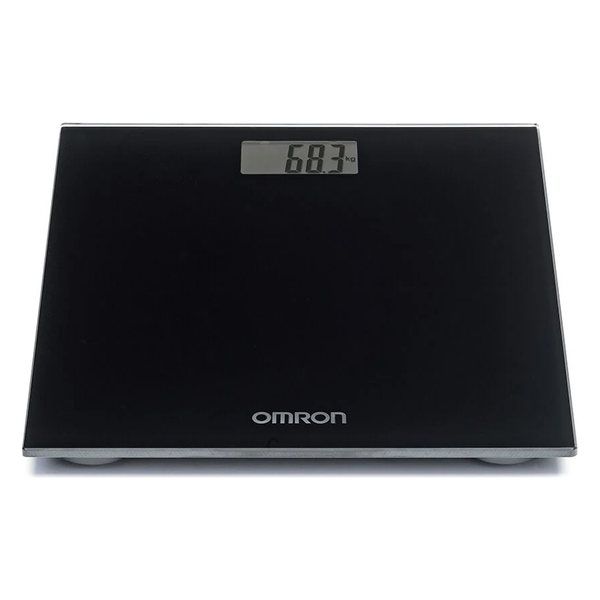
Low-cost pick
Omron HN289 digital scale: see it on Amazon (affiliate link, opens in a new tab)
About £20 to £25
- Measures
- Weight only
- App
- No
- Electrical current
- No
- Maximum weight
- 150kg
- Users
- Not stated
Affiliate link
Picture: Omron
Weight and BMI with app
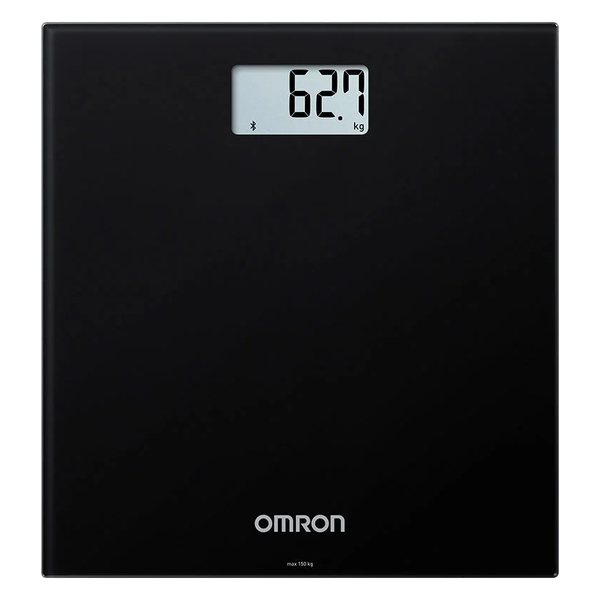
Omron HN300T2 Intelli IT: see it on Amazon (affiliate link, opens in a new tab)
About £25 to £35
- Measures
- Weight and BMI
- App
- Omron Connect
- Electrical current
- No
- Maximum weight
- Not stated
- Users
- 2, plus guest mode
Affiliate link
Picture: Omron
Body composition pick
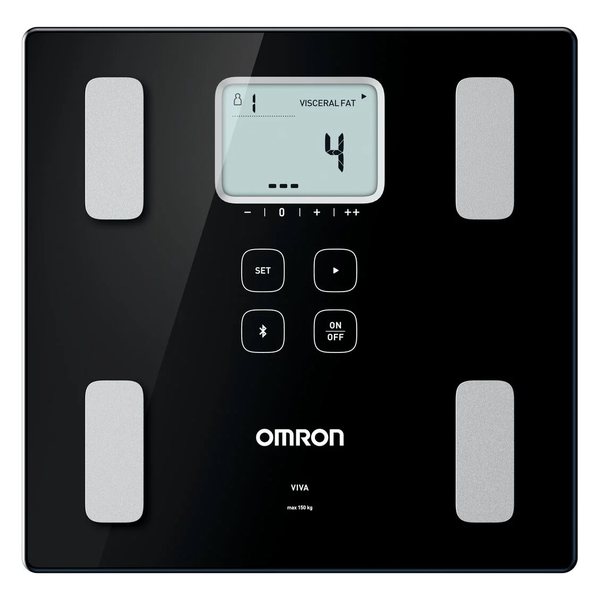
Omron VIVA body composition scale: see it on Amazon (affiliate link, opens in a new tab)
About £30 to £50
- Measures
- Weight, BMI, body fat, muscle
- App
- Omron Connect
- Electrical current
- Yes: not with a pacemaker
- Maximum weight
- Not stated
- Users
- Up to 4
Affiliate link
Picture: Omron
Low-cost smart scale
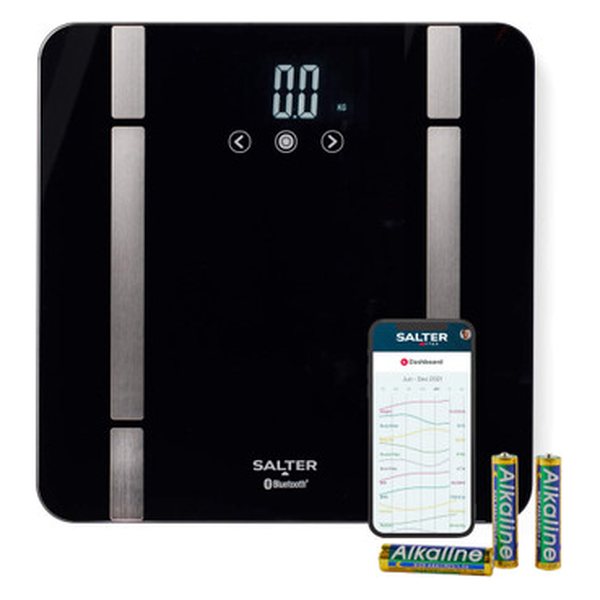
Salter Smart Bluetooth Bathroom Scale (SA00432): see it on Amazon (affiliate link, opens in a new tab)
About £28 to £30
- Measures
- Weight, BMI, fat, water, muscle, bone
- App
- Salter Health
- Electrical current
- Yes: not with a pacemaker
- Maximum weight
- 200kg
- Users
- Up to 8
Affiliate link
Picture: Salter
Basic and accurate: Omron HN289
Omron HN289 (opens in a new tab) (affiliate link) is a simple weight-only digital scale. Omron says it detects changes of 100g and takes up to 150kg. It has no app and no body fat feature, so it does not send a current through your body. Expect to pay about £20 to £25.
This is our low-cost pick.
Weight and BMI with an app: Omron HN300T2 Intelli IT
Omron HN300T2 Intelli IT (opens in a new tab) (affiliate link) measures weight and works out BMI. It syncs by Bluetooth to the free Omron Connect app, stores 30 readings and has two user profiles plus a guest mode. It has no body composition feature, so it does not send a current through your body. Expect to pay about £30.
Body composition: Omron VIVA
Omron VIVA (opens in a new tab) (affiliate link) estimates body fat, visceral fat, skeletal muscle and resting metabolism, as well as weight and BMI. It has up to four users and links to Omron Connect, alongside Omron blood pressure monitors. Omron says it is not for anyone with a pacemaker or other electronic implant, and gives weight only in pregnancy. Check the current price before you buy.
Low-cost smart scale: Salter Smart Bluetooth Bathroom Scale
Salter Smart Bluetooth Bathroom Scale (SA00432) (opens in a new tab) (affiliate link) syncs to the free Salter Health app. Salter says it estimates body fat, body water, muscle and bone mass as well as weight and BMI, takes up to 200kg and stores up to 8 users. Salter’s product page does not give a pacemaker warning, but it uses the same kind of electrical current as other body composition scales. Do not use it if you have a pacemaker or other implant. Expect to pay about £28 to £30.
The picks compared
| Feature | Omron HN289 | Omron HN300T2 | Omron VIVA | Salter smart scale |
|---|---|---|---|---|
| Measures | Weight | Weight and BMI | Weight, BMI, body fat, visceral fat, skeletal muscle, resting metabolism | Weight, BMI, body fat, body water, muscle, bone mass |
| App | None | Omron Connect | Omron Connect | Salter Health |
| Connection | None | Bluetooth | Links to Omron Connect | Bluetooth |
| Users | Not stated | 2, plus guest mode | Up to 4 | Up to 8 |
| Maximum weight | 150kg | Not stated | Not stated | 200kg |
| Electrical current | No | No | Yes: not with a pacemaker or implant | Yes: not with a pacemaker or implant |
| Price band | About £20 to £25 | About £30 | Check current price | About £28 to £30 |
“Not stated” means we could not find the figure on the maker’s UK page.
Which should you buy?
- Just want to track weight: Omron HN289.
- Want the numbers on your phone, or to share with your GP: Omron HN300T2.
- Curious about body fat, and no implants: Omron VIVA or the Salter smart scale.
Free NHS apps to go with your scale
A scale tells you what is happening. These free NHS apps help you change it:
- NHS Weight Loss Plan: a 12-week plan with a calorie target, food diary and weekly weigh-ins.
Download on the App Store: NHS Weight Loss Plan for iPhone or iPad (opens in a new tab) Get it on Google Play: NHS Weight Loss Plan for Android (opens in a new tab)
- NHS Couch to 5K: a 9-week plan that takes beginners to running for 30 minutes.
Download on the App Store: NHS Couch to 5K for iPhone or iPad (opens in a new tab) Get it on Google Play: NHS Couch to 5K for Android (opens in a new tab)
The NHS Better Health website also has free 10-minute home workout videos. For more on all of these, and on weight loss medicines, see NHS weight loss support.
Scales we checked and left out
- Withings Body Smart: we could not open Withings’ UK product page.
- RENPHO: RENPHO’s European shop does not sell to the UK, and we could not find a UK maker’s page.
- INSMART: we could not find a maker’s page.
- Fitbit Aria Air: shown as out of stock on the UK Google Store.
The old version of this page recommended RENPHO as its top pick, alongside INSMART, Fitbit Aria Air and Withings Body+. We could not re-check them on 28 October 2026, so they stay out until a maker’s UK page confirms each one is on sale.
If weighing yourself makes you anxious
Scales are not helpful for everyone. If you find yourself weighing many times a day, feeling panicky about the number, or cutting back food in a way that worries you or others, it is fine to put the scale away.
Beat, the UK eating disorder charity, runs a free, confidential helpline: England 0808 801 0677, Scotland 0808 801 0432, Wales 0808 801 0433, Northern Ireland 0808 801 0434. See the Beat helpline page. You can also talk to your GP.
When to get help
- Call 999 if someone is in immediate danger, including from an eating disorder.
- Call NHS 111 or use NHS 111 online for urgent medical advice.
- Contact your GP practice if you keep losing weight without trying, if your waist is more than half your height, or if you are worried about your weight or eating.
- Ask a pharmacist for advice on healthy weight and local NHS support.