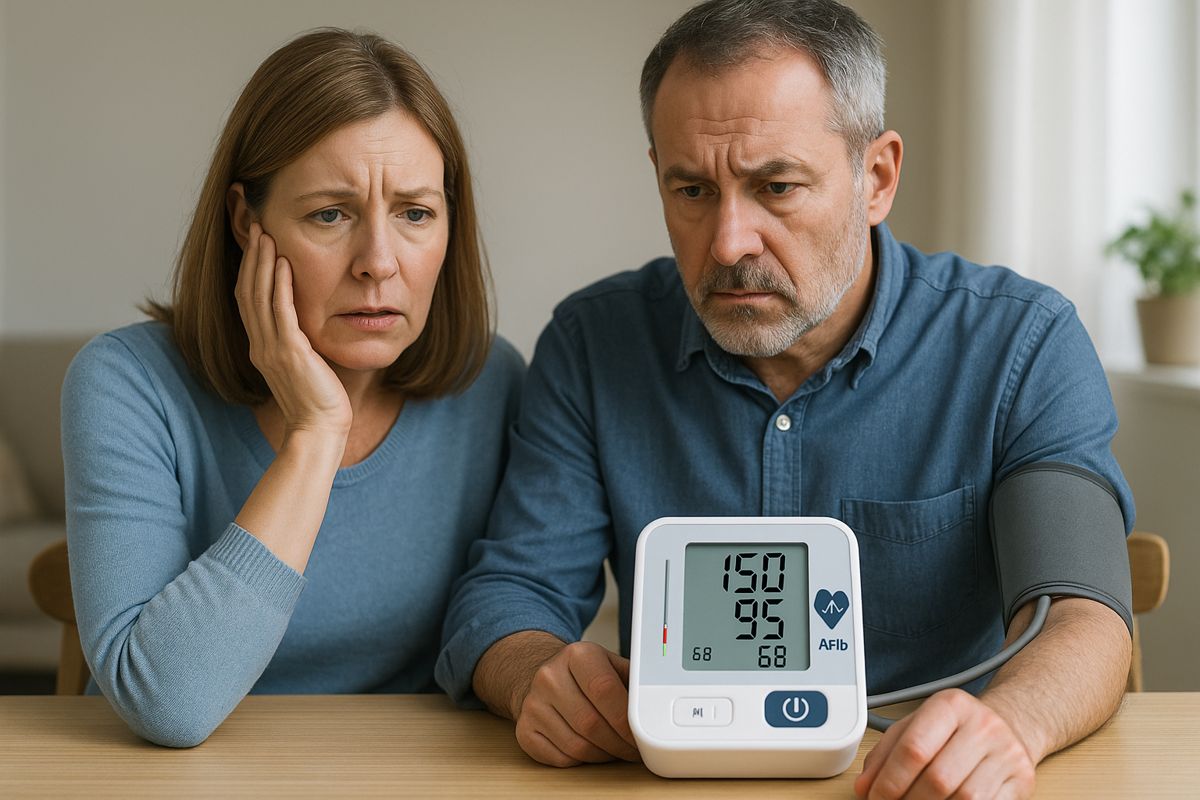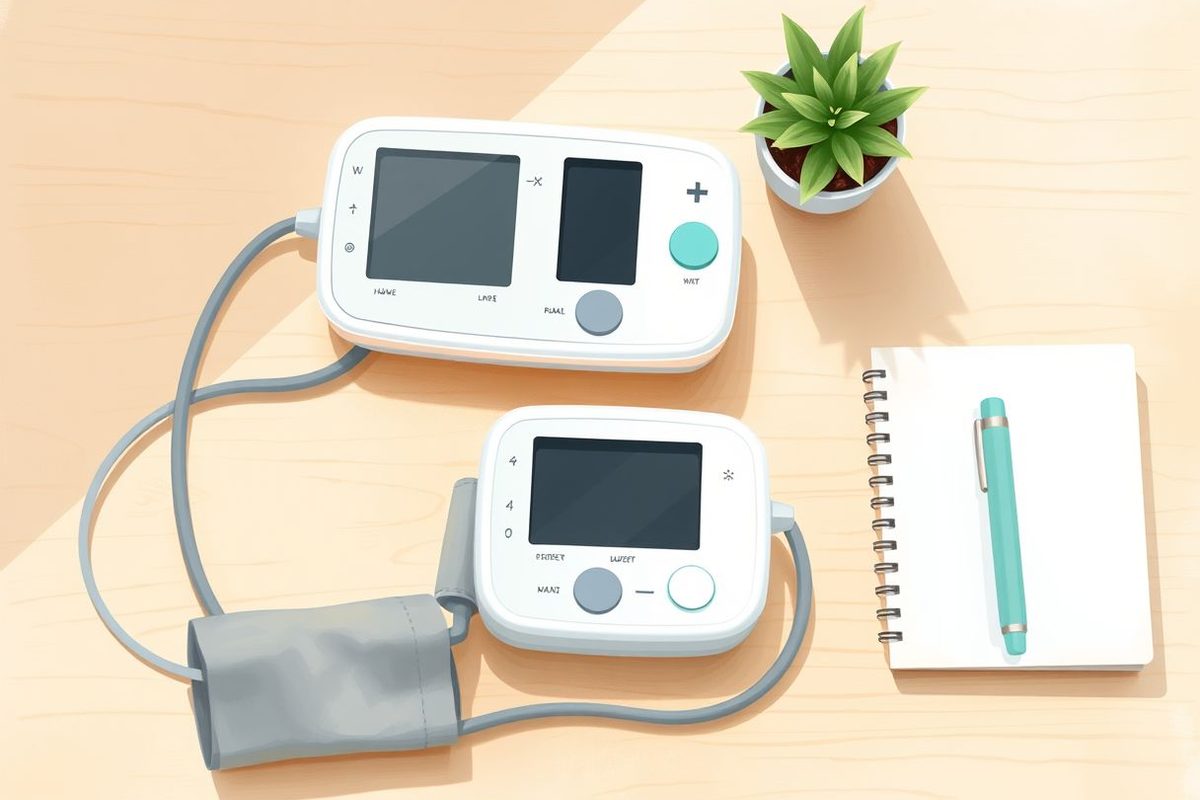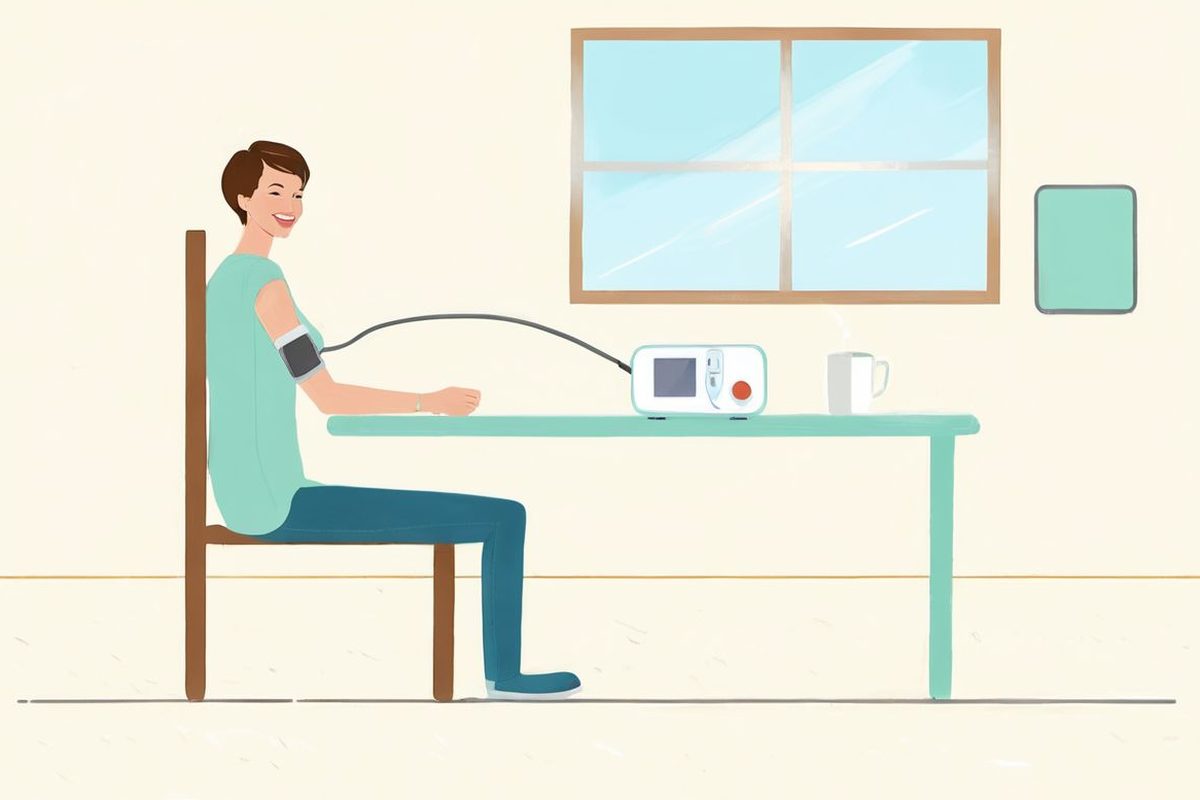
To check your blood pressure at home, sit quietly with your back supported, feet flat and arm resting on a table at heart height. Take two readings a minute apart and write both down. The NHS counts a home reading of 135/85 or above as high. At a GP surgery or pharmacy the line is 140/90. One high reading is not a diagnosis, so look at the pattern over several days.
This site is not part of the NHS. The chart on this page uses figures from the NHS, NICE, the British Heart Foundation (BHF) and Blood Pressure UK.
Why blood pressure matters
High blood pressure is often called the “silent killer” because it usually has no symptoms. Many people feel completely well and do not know they have it. The NHS says the only way to find out is to have your blood pressure checked.
If it stays high and is not treated, it strains your heart and blood vessels. The NHS and the BHF say this raises the risk of:
- heart disease, heart attacks and heart failure
- strokes
- kidney disease
- vascular dementia
- loss of vision
The good news is that lowering your blood pressure even a small amount helps reduce these risks. Blood Pressure UK says lowering it by 10 mmHg cuts your risk of a stroke or heart attack by about a fifth.
A large study published in The Lancet in 2021 pooled 48 trials of blood pressure medicines. On average, each 5 mmHg drop in the top number cut the risk of a major heart or circulation problem (heart attack, stroke or heart failure taken together) by about 10%. For heart attacks and other coronary heart disease on their own, the drop was about 8%.
When to get your blood pressure checked
The NHS says to get a check if you are 40 or over and have not had one for more than 5 years. The BHF and Blood Pressure UK also say healthy adults should be checked at least every 5 years. If you have been told your blood pressure is high, your GP practice will tell you how often to check.
You can have it checked at:
- a pharmacy. In England, many pharmacies offer a free check if you are 40 or over, live in England, have not been diagnosed with high blood pressure and have not had a check in the last 5 years. Use the NHS service to find a pharmacy that offers free blood pressure checks. Some pharmacies may charge.
- your GP surgery. Some surgeries have a monitor in the waiting room you can use.
- an NHS Health Check. In England, adults aged 40 to 74 without certain long-term conditions should be invited every 5 years. It includes a blood pressure test. If you think you are due one, contact your GP practice.
- some workplaces.
- at home, with a validated upper-arm monitor.
If you live in Scotland, Wales or Northern Ireland, the free pharmacy check and the NHS Health Check above are for England. Ask your GP practice or a local pharmacy what is offered where you live.
Blood Pressure UK, a charity, has more on getting a blood pressure check and on living with high blood pressure.
What the two numbers mean
A reading is written as two numbers, such as 130/80. The unit is mmHg (millimetres of mercury).
- The top number (systolic) is the highest pressure, when your heart pumps.
- The bottom number (diastolic) is the lowest pressure, when your heart relaxes between beats.
How to measure your blood pressure at home
Use a monitor with an upper-arm cuff that has been independently checked for accuracy. Our guide on choosing a validated monitor explains how to check.
Before you start
- Get the cuff size right. Measure around your upper arm, halfway between your elbow and shoulder, with a cloth tape. Check the number against the size printed on the cuff. A cuff that is too small or too large can give a wrong reading.
- Wait half an hour after coffee, food, smoking or exercise. Blood Pressure UK says not to measure within half an hour of eating, smoking, having caffeinated drinks such as coffee, or exercising, because these can push your blood pressure up for a while. Omron, a monitor maker, adds alcohol and bathing to the list.
- Go to the toilet first, if you need to. Blood Pressure UK suggests this too.
- Wear short sleeves. Roll up your sleeve or take off long sleeves, so the cuff goes on bare skin.
- Rest first. Sit quietly for 5 minutes. Try to feel calm before you start.
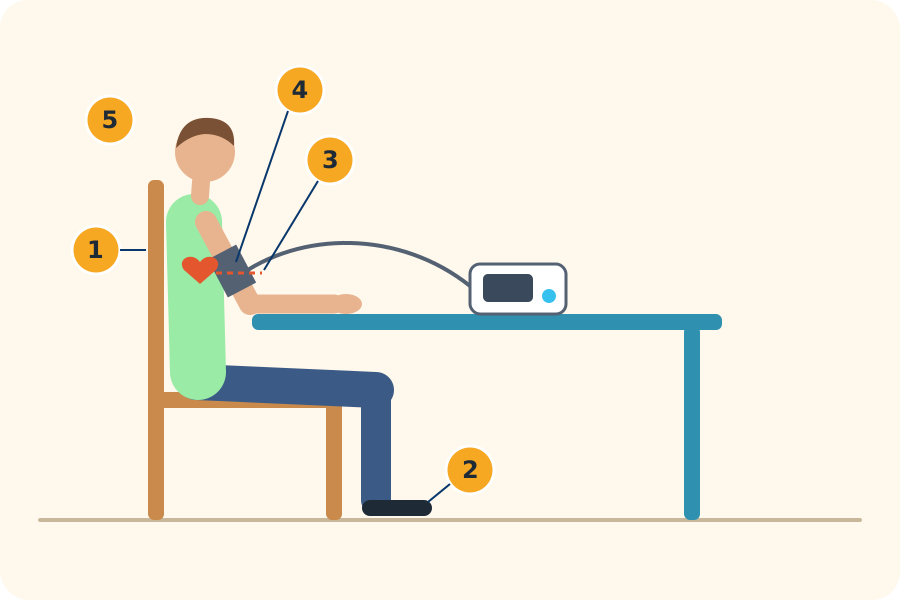
- Back supported against the chair.
- Feet flat on the floor, legs not crossed.
- Forearm resting on a table, so the cuff is level with your heart.
- Cuff on bare skin, about 1 to 2 cm above the elbow.
- Stay still and don’t talk while the cuff inflates.
Taking the reading
- Sit on an upright chair with a back. Keep your feet flat on the floor and do not cross your legs.
- Rest your arm on a table so the cuff is level with your heart. Keep your hand relaxed and do not clench your fist.
- Put the cuff on about 1 to 2 cm above your elbow, with the tube running down the middle of your arm.
- Fasten it so you can just slide two fingers underneath.
- Press start. Do not talk or move while the cuff inflates and deflates.
- Write down both numbers, plus your pulse if the monitor shows it.
- Wait 1 minute and take a second reading. If the two are very different, take a third.
Why arm position matters
The BHF reported on a study that checked readings in three arm positions. With the arm hanging by the side, the top number was 6.5 mmHg higher on average than with the arm on a desk at heart level. With the arm resting on the lap, it was 3.9 mmHg higher. The BHF warns that a low table, below heart level, could also push readings up.
Why home readings help
Being measured at a surgery can make some people’s blood pressure go up for a short time. This is often called the “white coat effect”. A clinic check is also just one moment. Readings taken calmly at home over several days give a fuller picture of your usual blood pressure. That is why the home line for high blood pressure (135/85) is lower than the clinic line (140/90).
Home readings only help if they are taken properly, so follow the steps above each time.
When to check
If your GP practice has asked for home readings, follow their instructions. The NHS says readings are usually taken twice a day, morning and evening, and your doctor or nurse will tell you for how many days. Our guide to doing a week of readings for your GP explains how.
UK blood pressure chart
The ranges below come from the BHF. The “Healthy” and “Slightly raised” rows are the BHF’s, and are for readings taken by a healthcare professional. The high thresholds match the NHS and NICE, and the low threshold is the NHS one.
The home line for high blood pressure is 5 points lower than the clinic line. So at home, 135/85 or above counts as high, even though it falls in the slightly raised row.
| What it means | Top number (systolic) | Bottom number (diastolic) |
|---|---|---|
| Low | Below 90 | Below 60 |
| Healthy | 90 to 129 | 60 to 84 |
| Slightly raised | 130 to 139 | 85 to 89 |
| High, checked at home | 135 or above | 85 or above |
| High, checked at a GP surgery or pharmacy | 140 or above | 90 or above |
If your two numbers land in different rows, take the higher row seriously.
Blood Pressure UK uses a slightly tighter band. It calls 90/60 up to 120/80 “ideal” blood pressure.
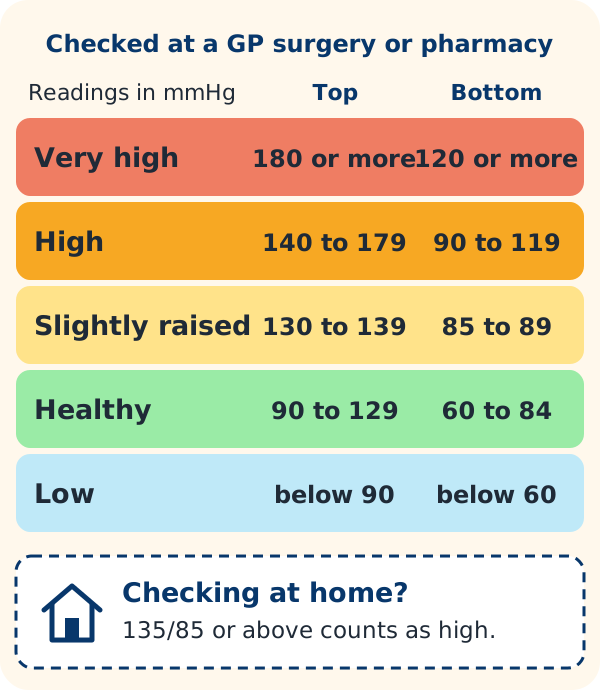
The coloured bands are for readings taken by a healthcare professional. “Very high” is the level NICE counts as severe, 180/120 or higher. At home, 135/85 or above counts as high.
Check your reading with the NHS tool
The NHS has a free online tool, Check your blood pressure reading. It shows your reading on a chart and gives you a result and advice on what to do next. It is useful if you have just bought a monitor, or a smartwatch has told you your blood pressure may be high.
- Have a recent reading ready, from home or from a healthcare professional.
- Open the tool and press the green Start now button.
- Answer the questions and enter your reading.
- Read the result and the advice on what to do next.
The tool is for adults aged 18 or over. The NHS says it is not for anyone who is pregnant, has a condition or takes medicines that affect blood pressure, has recently had surgery or an injury, feels unwell with new symptoms, or has recently had medical advice about their blood pressure. It is not a symptom checker. If you have symptoms, use NHS 111 online or call 111.
How doctors grade high blood pressure
NICE guidance uses an average of readings, not a single one. Home averages have their own thresholds.
| Stage | Clinic reading | Average of home readings |
|---|---|---|
| Stage 1 | 140/90 to 159/99 | 135/85 to 149/94 |
| Stage 2 | 160/100 to 179/119 | 150/95 or above |
| Severe (stage 3) | Top number 180 or above, or bottom number 120 or above | Not set |
Blood pressure by age
Blood pressure tends to rise as we get older, but what is common is not the same as what is healthy.
Why does blood pressure rise with age?
The BHF explains that as we age, our arteries change and become stiffer, and this can push blood pressure up. The NHS lists getting older as a risk factor. Habits also add up over the years, such as eating a lot of salt, being overweight, drinking too much alcohol, not being active and long-term stress.
What is a healthy blood pressure for my age?
The healthy range does not go up with age. Blood Pressure UK says its chart, with 90/60 up to 120/80 as ideal, suits adults of any age, and that the cut-off for diagnosing high blood pressure does not change with age. The BHF counts readings up to 129/84 as healthy.
Some websites use 130/80 as the line for high blood pressure. That is a US threshold. In the UK, the NHS and NICE use 135/85 for the average of home readings and 140/90 at a surgery or pharmacy.
How common high blood pressure is
The Health Survey for England 2022, published by NHS England, measured blood pressure in adults across England. It counted someone as having high blood pressure if their reading was 140/90 or above, or they were taking blood pressure medicine. These are population figures, not targets.
| Group (England, 2022) | Share with high blood pressure |
|---|---|
| All adults | 30% |
| Men, all ages | 34% |
| Women, all ages | 27% |
| Men aged 75 and over | 66% |
| Women aged 75 and over | 71% |
The same survey found high readings in people not taking blood pressure medicine rose with age, from 3% of those aged 16 to 34 to 21% of those aged 75 and over. Overall, 11% of adults had high blood pressure that had not been diagnosed.
Treatment targets by age
Once someone is being treated for high blood pressure, NICE sets targets by age:
| Age | Target at a clinic | Target for the average of home readings |
|---|---|---|
| Under 80 | Below 140/90 | Below 135/85 |
| 80 and over | Below 150/90 | Below 145/85 |
These are treatment targets, not a definition of healthy. For people who are frail or have several long-term conditions, NICE asks clinicians to use their judgement. Some conditions, such as severe kidney disease or type 1 diabetes, have different targets. Your GP or nurse may agree a different target with you, so check with them.
How to lower your blood pressure
Healthy changes can bring blood pressure down, whether or not you also take medicine. The NHS recommends:
- Eat less salt. Adults should have no more than 6g of salt a day, about 1 level teaspoon. Much of it is already in bread, ready meals and processed food, so check labels.
- Eat a healthy, balanced diet, with plenty of fruit and vegetables.
- Be active. Aim for at least 150 minutes of exercise a week. A brisk walk counts.
- Lose weight if you are overweight.
- Cut down on alcohol. Do not regularly drink more than 14 units a week.
- Cut down on caffeine, such as coffee, tea and cola.
- Stop smoking.
Salt makes a measurable difference. A review in the BMJ pooled 34 trials. Cutting salt by about 4.4g a day lowered the top number by about 4 mmHg on average, and by about 5 mmHg in people with high blood pressure.
NHS Better Health has free tools to help you lose weight, get active, stop smoking and drink less.
If you have been prescribed blood pressure medicine, keep taking it while you make these changes. Do not stop or change your medicine unless your GP, nurse or pharmacist tells you to.
Keep going
Blood pressure can change. Whether you start well above the healthy range or only slightly above it, the changes above can help. Keep checking, and share your readings with your GP practice, who can tell you whether your plan is working.
Take-home message
Knowing your blood pressure is a starting point, not a finish line. Use your readings to stay curious, consistent and connected with your GP practice.
Low blood pressure
The NHS defines low blood pressure as below 90/60. It does not always cause symptoms, and it can be normal for people who are fit or for whom it runs in the family. It matters more if you keep feeling dizzy, lightheaded or faint, especially when you stand up.
What people say about checking at home
In April 2022, Healthwatch England, the independent champion for people who use health and care services, published a report on home blood pressure monitoring. NHS Digital asked it to help evaluate the NHS BP@Home programme, which gave monitors to patients. The survey had 484 responses, plus 26 in-depth interviews.
What it found:
- People monitor for many reasons. One in two said it was because they were in a higher-risk group.
- Nine in ten found it easy to take readings, but only six in ten found it easy to send them to their GP practice.
- Some people prompted by their GP practice to monitor were never asked to send their readings in. The report puts this at one in four.
- 61% said nobody had clearly explained what happens to their readings once they are sent.
- Most feelings people described were positive, such as peace of mind and feeling in control (69%). Some felt negative (14%), most often anxious or worried.
- Of those not already using one, 72% would definitely or probably use an app or website to send readings.
Healthwatch asked the NHS to give clearer information on why and how to monitor, easier ways to send readings, and feedback once readings are sent.
What this means for you: when your practice asks for readings, ask how to send them and what will happen next. Practices differ. Many accept readings through their online consultation form or the contact form on the practice website. Our guide to sending blood pressure readings to your GP explains more.
When to get help
Call 999 if you have chest pain or discomfort that does not go away, or pain that spreads to your arm, neck, jaw, stomach or back. Also call if you have chest pain and feel sweaty, sick, lightheaded or short of breath. Do not drive yourself to A&E.
Call 999 if you notice signs of a stroke: a drooping face, weakness in one arm, or slurred or confused speech. Call even if the signs have gone away.
If a reading is very high, sit quietly for a few minutes and check again. NICE counts a clinic reading of 180/120 or higher as severe, and the BHF says to get urgent medical help if your blood pressure is dangerously high. If your reading stays at that level, or is much higher than usual for you, get advice the same day from your GP practice or NHS 111 (online or by phone). If you also feel unwell, confused or have chest pain, call 999.
Use NHS 111 (online or by phone) if you often get headaches or blurred vision, or chest pain that comes and goes.
Contact your GP practice (not urgently) if:
- your home readings average 135/85 or more
- you keep feeling dizzy or faint, which could mean your blood pressure is low
- your monitor keeps showing an irregular heartbeat symbol
Ask a pharmacist for a blood pressure check if you are 40 or over and have not had one for 5 years.