For most homes, a simple digital stick thermometer is the best first buy. It is cheap, accurate and it is what the NHS suggests for babies and young children, used under the arm. An ear thermometer is quicker for older children and adults, but it has to be placed correctly. A temperature of 38C or above counts as high.
Which type suits whom
There are three main types. Each has a job.
| Type | Best for | Watch out for |
|---|---|---|
| Digital stick | Everyone, and the NHS choice for children under 5 (under the arm) | Takes a little longer; child must keep still |
| In-ear (tympanic) | Older children and adults who want a reading in seconds | Can mislead if not placed right, more likely in babies; costs more |
| No-contact forehead (infrared) | Not recommended | The NHS advises against infrared thermometers, as some do not meet UK rules |
What the NHS says for babies and children
The NHS says to use a digital thermometer in the armpit for children under 5. It says ear thermometers are quick but can give a misleading reading if not placed correctly, and that this is more likely in babies.
Forehead strips are not accurate, because they measure skin rather than body temperature. Never use an old glass mercury thermometer. If one breaks and a child is exposed to the mercury, get medical advice straight away.
What the NHS says for adults
For adults, a digital thermometer can go under the tongue or in the armpit. Ear thermometers are fine if you follow the instructions. The NHS advises against glass thermometers, forehead strips and infrared thermometers, because some infrared models do not meet UK regulations.
In-ear or no-contact: how they compare
No-contact forehead thermometers are popular because you can check a sleeping child without waking them. But the NHS advises against infrared thermometers, so we suggest a digital stick or an ear thermometer instead. This table shows the main differences.
| Feature | In-ear thermometer | No-contact forehead thermometer |
|---|---|---|
| What the NHS says | Fine if you follow the instructions. For under-5s, the NHS prefers a digital thermometer under the arm | Advises against infrared thermometers, as some do not meet UK regulations |
| Speed | A second or two | A second or two |
| Sleeping child | Has to go in the ear, so may wake them | No contact needed |
| What can upset the reading | Not placing it correctly; a lot of earwax | Sweat, hair on the forehead, a recent change in room temperature, holding it at the wrong distance |
| Hygiene | Uses a disposable cap or filter each time | Nothing touches the skin |
| Running costs | Replacement caps or filters | None |
If you already have a no-contact thermometer
The MHRA has warned that some infrared thermometers sold in the UK do not meet medical device rules. Before you rely on one, check the box or the thermometer shows the maker’s name and address, the model number, a batch or lot number, and a CE mark with a 4-digit number next to it (or a UKCA mark). If these are missing, the MHRA says not to buy or use it.
If you use one, Braun gives these tips for its no-touch models:
- Let the thermometer settle at room temperature for at least 10 minutes before you use it.
- Move hair away from the forehead, then wait 10 minutes before measuring.
- Wipe away any sweat with a dry cloth.
- Hold it at the distance the instructions give.
If the reading seems wrong, or the person seems unwell whatever the number, check again with a digital thermometer.
How to take a temperature properly
Under the arm (best for children under 5)
- Sit your child comfortably on your knee.
- Place the tip of the digital thermometer high in their armpit.
- Gently hold their arm against their side.
- Wait for the time in the leaflet (often about 15 seconds) or for the beep.
- Read the display.
If your child has just had a bath or been wrapped in a blanket, wait a few minutes first. The reading can be falsely high.
Under the tongue (adults)
- Place the tip under your tongue.
- Close your lips around it.
- Wait for the beep, then read it.
In the ear
Follow the maker’s instructions closely. Use a fresh hygiene cap or lens filter each time if the model needs one: Braun says to replace the filter every time you take a reading. Make sure the ear is as clear as possible. Braun advises against using an ear thermometer if there is a lot of earwax, because it can affect the reading. Take two readings if you are unsure.
What the numbers mean
- Normal: around 36.4C, though it varies between people and through the day.
- High temperature (fever): 38C or above.
You can still have a high temperature with a lower reading if you feel hot, cold or shivery. Trust how the person seems, not just the number.
Our picks
We looked only at models whose maker’s page we opened. Prices move, so we give a rough band. We have not included a no-contact forehead thermometer, because the NHS advises against infrared thermometers for home use.
Low-cost pick
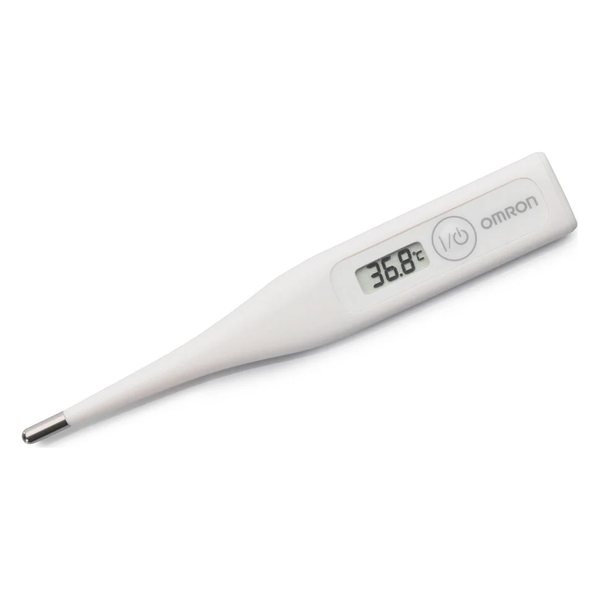
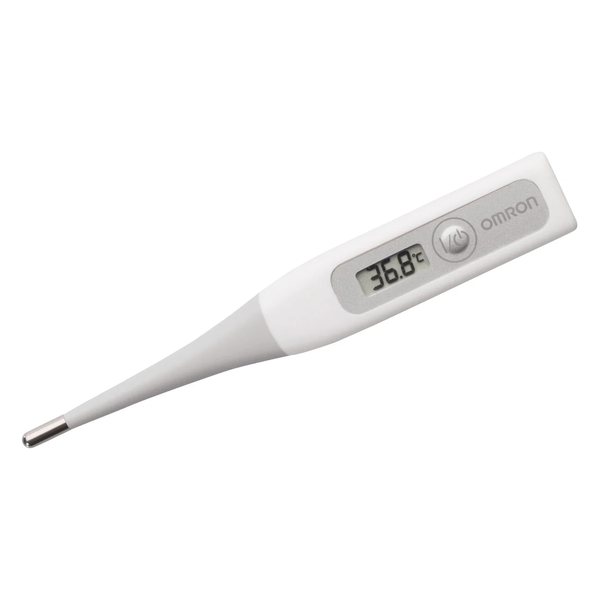
Omron Eco Temp Basic: see it on Amazon (affiliate link, opens in a new tab)
Under £10
- Type
- Digital stick
- Where it's used
- Under the arm or in the mouth
- Reading time
- Not stated
- Memory
- Last reading
- Best for
- Under-5s (NHS choice)
Affiliate link
Picture: Omron
Soft-tip pick
Omron Flex Temp Smart: see it on Amazon (affiliate link, opens in a new tab)
About £8 to £12
- Type
- Digital stick, soft tip
- Where it's used
- Under the arm or in the mouth
- Reading time
- Not stated
- Memory
- Last reading
- Best for
- Families wanting a softer tip
Affiliate link
Picture: Omron
Budget ear pick
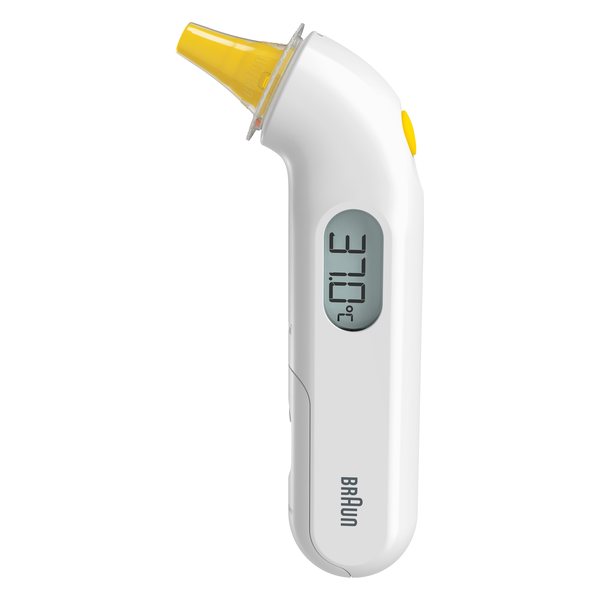
Braun ThermoScan 3: see it on Amazon (affiliate link, opens in a new tab)
About £20 to £30
- Type
- In-ear
- Where it's used
- In the ear
- Reading time
- About 1 second
- Memory
- Not stated
- Best for
- Older children and adults
Affiliate link
Picture: Braun
Premium ear pick
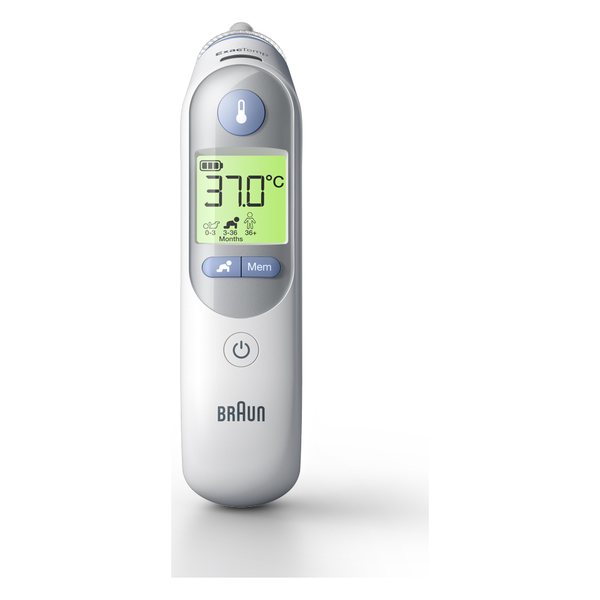
Braun ThermoScan 7: see it on Amazon (affiliate link, opens in a new tab)
About £40 to £55
- Type
- In-ear, with Age Precision
- Where it's used
- In the ear
- Reading time
- Not stated
- Memory
- Last 9 readings
- Best for
- Older children and adults
Affiliate link
Picture: Braun
Low-cost digital stick: Omron Eco Temp Basic
Omron Eco Temp Basic (opens in a new tab) (affiliate link) is a basic digital stick thermometer for use under the arm or in the mouth. It is water resistant and remembers the last reading. It is the kind of thermometer the NHS suggests for under-5s. Expect to pay under £10.
Digital stick with a soft tip: Omron Flex Temp Smart
Omron Flex Temp Smart (opens in a new tab) (affiliate link) is similar but has a soft, flexible tip, which some families find more comfortable. Use it under the arm or in the mouth. It recalls the last reading. Expect to pay about £8 to £12.
Budget ear thermometer: Braun ThermoScan 3
Braun ThermoScan 3 (opens in a new tab) (affiliate link) gives a reading in about one second. It beeps once for normal, twice for raised and four times for high. It comes with 21 disposable hygiene caps. Braun says it is for home use and is not designed to read very low temperatures. Expect to pay about £20 to £30.
Premium ear thermometer: Braun ThermoScan 7
Braun ThermoScan 7 (opens in a new tab) (affiliate link) adds “Age Precision”. You choose an age group (0 to 3 months, 3 to 36 months, or over 36 months) and the screen colour shows whether the reading counts as a fever for that age. It has a pre-warmed tip and stores the last nine readings. Expect to pay about £40 to £55.
Remember: for children under 5, the NHS still prefers a digital thermometer under the arm.
What to look for when you buy
- One button. In the middle of the night you want to switch it on and take a reading without reading the instructions again.
- A clear display you can read in the dark, so you do not have to put the big light on. Check the box or maker’s page, as not every model has a backlit screen.
- Running costs. Ear thermometers use a disposable cap or lens filter for each reading. Braun’s replacement filters come in packs of 40, so factor them into the price.
- Memory, if you want to look back at earlier readings.
Which should you buy?
- Young children in the house: a digital stick, such as the Omron Eco Temp Basic. Keep it in your first aid kit.
- Older children and adults: a digital stick is enough. Add an ear thermometer if you want speed.
- Older parent: a digital stick with a clear display is simple and reliable.
A thermometer can flag a high temperature. It cannot tell you what is causing it. That needs a clinician.
A good thermometer can last for many years, so it can be worth paying a little more for one you find easy to use.
When to get help
Call 999 if a child has a high temperature and:
- a rash that does not fade when you press a glass against it
- a stiff neck, or is bothered by light
- a fit (febrile seizure) for the first time
- blue, grey, pale or blotchy skin, lips or tongue
- difficulty breathing, or very fast breathing
- is drowsy and hard to wake, or very confused or agitated
- unusually cold hands and feet, or is not responding as normal
Call NHS 111 or use NHS 111 online if a child:
- is under 3 months old with a temperature of 38C or higher
- is 3 to 6 months old with a temperature of 39C or higher
- has a high temperature with other signs of illness, such as a rash
- has had a high temperature for 5 days or more
- is not eating, not themselves and you are worried
- seems dehydrated, for example few wet nappies, sunken eyes or no tears
For adults, ask your GP practice for an urgent appointment, or contact NHS 111, if a high temperature is not getting better with home treatment or is getting worse.
A pharmacist can advise on paracetamol or ibuprofen and the right dose. Not sure where to go? See which NHS service to use.